I hear a lot about data in retail media these days.
First-party data. Purchase data. Closed-loop attribution. Clean rooms. Identity graphs.
It's become the centerpiece of nearly every conversation.
And to be clear, it matters. A lot.
But I've started to wonder if, in focusing so heavily on data, we're quietly losing something even more important.
Shopper attention.
Retail media was built on attention first
Before retail media networks, before sponsored product ads, before data became the headline, retailers had something incredibly powerful:
People showing up with intent to buy.
- Walking into a store
- Browsing a category
- Opening an app to make a purchase
These are high-value moments, not because of who the shopper is on paper, but because of what they're about to do.
Now data is leading the story
Recently, I was speaking with someone who had just joined a major retail chain to oversee their retail media business.
Naturally, I was curious how they were thinking about building it.
I asked about their priorities, where they saw differentiation, how they were thinking about the in-store experience.
The answer?
Data.
Monetizing their data. Packaging their data. Scaling their data.
That was the focus. Full stop.
And again, that's not wrong. Data is incredibly valuable.
But it struck me that the conversation never touched on:
- The shopper experience
- The physical or digital environment
- The moments where influence actually happens
It was all about who the shopper is, not what the shopper is doing.
What we used to do differently
When I was at Bed Bath & Beyond, we partnered with Cotton Inc on a campaign to promote products that met specific cotton criteria.
It wasn't just targeting an audience.
It was a true retail media experience.
We:
- Inserted printed Cotton-branded cards into shopping bags and e-commerce packages
- Labeled qualifying products across the site with the Cotton logo
- Built a curated "Cotton Shop" featuring relevant items
- Promoted that shop through dedicated email and homepage placements
Everything worked together.
The result wasn't just impressions, it was:
- A clear brand story
- A guided shopping experience
- And a measurable lift across the featured products
How that might look today
Today, that same campaign might be approached very differently.
It might become:
- A DSP audience segment
- "Users who purchased or browsed cotton products in the last 12 months"
- Activated across programmatic channels
And to be clear, that's not a bad strategy.
But it's also… a lot less interesting.
And more importantly:
It removes the retailer's unique environment from the equation.
What gets lost when attention and context fade
When we reduce retail media to audiences and impressions:
- The store becomes just another distribution point
- The website becomes just another ad surface
- The experience becomes fragmented
We may still be reaching the "right" person, but we're no longer:
- Guiding their journey
- Shaping their decisions in real time
- Or taking advantage of high-intent moments
And that impacts measurement and outcomes more than we think
Retail media loves to talk about results.
Closed-loop attribution. Sales lift. ROAS.
But here's the part that doesn't get enough attention:
If the media itself isn't built around strong moments of attention and context, then measurement becomes less meaningful.
- You can attribute a sale
- But you may not understand what actually influenced it
- Or whether the experience could have driven even more impact
If attention and context weaken, measurement and outcomes become less valuable, no matter how strong the data is.
Are we losing creativity along the way?
This is the bigger question.
In chasing scale through data, are we:
- Losing the creativity that made retail media powerful?
- Moving away from integrated, high-impact programs?
- Defaulting to audience buying because it's easier to package and sell?
Because the best retail media doesn't just find the right shopper.
It:
- Shows up at the right moment
- In the right environment
- With a cohesive experience
The opportunity: bring it back together
This isn't about choosing between data and experience.
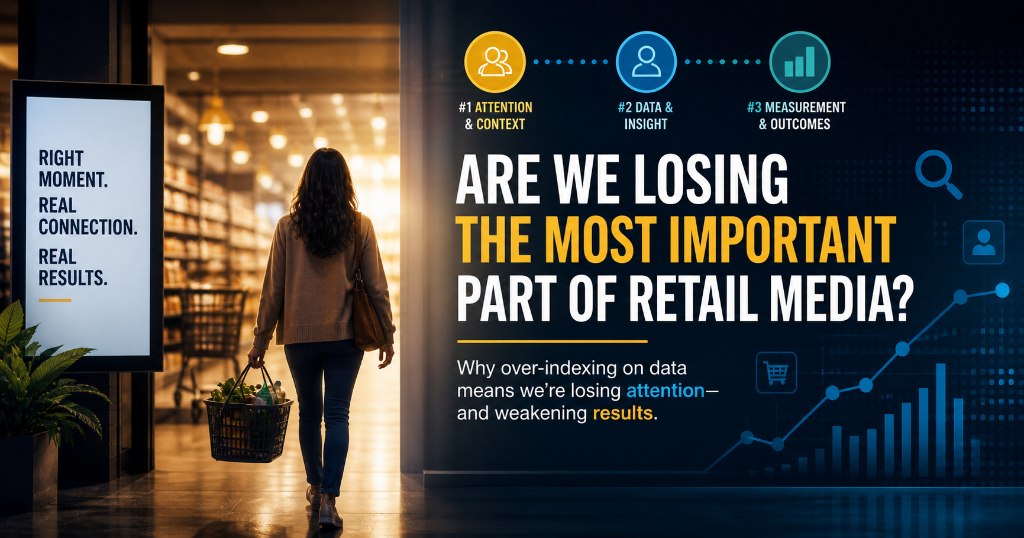
The real opportunity is combining them:
- Attention and context
- Data and insight
- Measurement and outcomes
The retailers and media owners who win won't be the ones with the most data.
They'll be the ones who:
Turn their environments into experiences, and use data to enhance them, not replace them.
Final thought
Retail media didn't become powerful because it could target audiences.
It became powerful because it sits at the intersection of:
attention, intent, and action.
If we reduce it to just data and targeting, we risk turning something differentiated into something interchangeable.
And that's a loss, not progress.